Why Diesel Prices Are Still High — and Why It’s Dragging the U.S. Economy Down
Current U.S. National Average Road Diesel Price
Why Diesel Prices Are Still High – As of the latest weekly data in January 2026, the U.S. national average on-highway diesel price sits at approximately:
$3.53 per gallon (weekly retail average)
This is the price truck drivers, fleets, farmers, construction operators, and manufacturers are paying at the pump nationwide. While headlines may suggest prices have “stabilized,” that stability exists at a level that continues to strain supply chains, suppress wages, and embed inflation across the economy.
Diesel has not corrected downward in proportion to crude oil, inflation easing, or historical norms. That disconnect is not accidental.
Why Diesel Prices Are Stuck at Elevated Levels
Diesel pricing is not driven by a single factor. It is the outcome of layered policy decisions, structural constraints, and global market pressures that collectively keep prices elevated even when conditions suggest relief should occur.
1. Crude Oil Costs (The Base Input, Not the Full Story)
Crude oil remains the foundational input for diesel fuel. Global crude prices respond to:
Supply controls and production targets
Geopolitical instability
Strategic reserve decisions
Coordinated output management by oil-producing nations
When crude rises, diesel follows. However, when crude falls, diesel does not decline proportionally. The spread between crude and diesel has widened over time due to downstream constraints, not upstream scarcity.
Crude explains the floor — not the ceiling.
2. Refining Constraints and Ultra-Low Sulfur Diesel Rules
Diesel requires more complex refining than gasoline, particularly due to ultra-low sulfur diesel (ULSD) requirements. This adds cost at every stage of production.
More importantly, U.S. refining capacity has been permanently reduced:
Refineries have closed or converted to renewable fuels
New refinery construction is effectively blocked by regulatory risk
Long-term investment has dried up due to policy hostility toward fossil fuels
Refineries that remain operational are running near capacity and enjoying historically high margins. When refining becomes the bottleneck, diesel prices stay high regardless of crude supply.
This is not a temporary issue — it is structural.
3. Diesel Is Exported While Domestic Users Pay the Price
The United States exports a significant portion of its refined diesel, particularly to:
Latin America
Europe
Regions affected by sanctions or refinery shortfalls
There is no domestic priority requirement for diesel fuel. Refiners sell to the highest bidder, and export markets often command premiums above U.S. trucking demand.
As a result, American truckers, farmers, and manufacturers are forced to compete with foreign buyers for fuel refined domestically.
That is not a free-market efficiency — it is a policy gap.
4. Taxes and Fees Were Never Rolled Back
Diesel carries:
Higher federal excise taxes than gasoline
State and local fuel taxes
Environmental compliance costs
Carbon-related fees in select states
None of these were meaningfully reduced during inflation spikes.
None were suspended to protect supply chains.
None are temporary.
Diesel is taxed as if it were discretionary consumption — not the critical infrastructure fuel it actually is.
5. Global Market Pressure and Coordinated Supply Control
Organizations such as OPEC continue to influence global oil supply by managing production targets that prevent prices from falling below desired levels.
Diesel, as a refined product, experiences amplified effects:
Supply cuts raise crude prices
Refining constraints magnify the impact
Export demand locks in higher pricing floors
Even strong domestic oil production cannot fully offset coordinated global supply control.
6. Government Data Explains the “What,” Not the “Why”
Agencies like the Energy Information Administration report:
Inventory levels
Weekly price averages
Regional price differences
What they do not address is why diesel remains expensive relative to historical norms, or how long this condition will persist.
A “stable” diesel price at $3.50+ is still economically damaging.
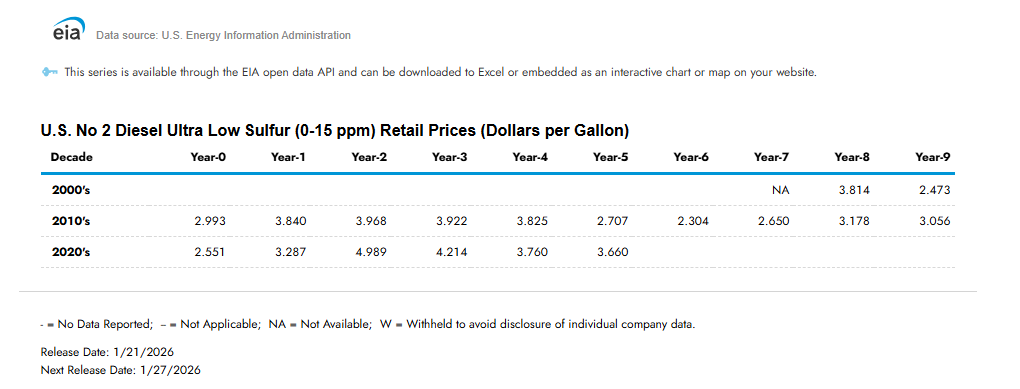
10-Year Diesel Price Trend: Normalized Highs
What the Last Decade Shows
Over the past 10 years, diesel prices have:
Established higher price floors after each spike
Recovered downward more slowly than gasoline
Failed to return to pre-crisis baselines after shocks
Key observations:
Post-2015 diesel prices never fully normalized
COVID-era volatility permanently reset pricing bands
The 2022–2024 spike created a new long-term floor
In practical terms, diesel has ratcheted upward — not cycled.
A 10-year chart shows fewer troughs and higher averages with each cycle, confirming that today’s pricing is not an anomaly, but a new baseline.
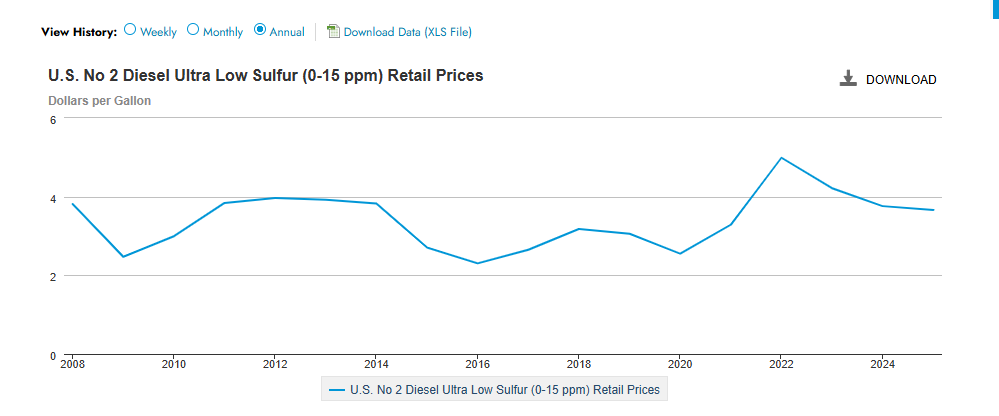
20-Year Diesel Price Trend: Structural Shift, Not Inflation
What Two Decades Reveal
Looking at a 20-year diesel price graph, the pattern is unmistakable:
Early 2000s: Diesel tracked closely with crude
Post-2008: Refining margins widened
Post-2015: Environmental and regulatory costs escalated
Post-2020: Capacity loss locked in permanent premiums
Diesel pricing has decoupled from inflation-adjusted historical norms.
Even when adjusted for inflation, current diesel prices are:
Elevated relative to trucking productivity
Detached from wage growth
Misaligned with consumer purchasing power
This is not inflation alone — it is policy-induced cost persistence.
The Economic Fallout No One Talks About
Trucking
Small carriers exit quietly
Independent drivers absorb costs without pricing power
Driver pay stagnates while operating costs rise
Capacity becomes fragile and volatile
Construction and Manufacturing
Material transport costs inflate bids
Projects delay or scale back
Productivity declines
Capital investment slows
Consumers
Grocery and retail prices remain “sticky”
Inflation never fully retreats
Cost increases compound invisibly through logistics
Diesel is embedded inflation. You don’t see it labeled on receipts — but it’s in everything.
Bottom Line
Diesel prices remain high because:
Refining capacity was allowed to shrink
Export markets are prioritized over domestic stability
Taxes and fees were never rolled back
Global supply is strategically constrained
Trucking has no political leverage
The system is functioning exactly as designed — just not for the people who move the economy.
Until diesel is treated as critical economic infrastructure, prices will remain elevated, margins will stay thin, and inflation will remain embedded across every sector that relies on transportation.